
The short answer
Do not rent a car for Madrid. Not for a weekend, not for a week, not to save on taxis. The centre is a restricted traffic zone with camera enforcement, the streets in the old barrios were laid out for mules, on-street parking is regulated in favour of residents, and a garage space costs roughly what an extra night of your apartment does. Meanwhile the Metro reaches almost everywhere you want to go and the historic centre is walkable end to end in about forty minutes.
So the useful version of this guide is not "which barrio has parking". It is: book anywhere central, walk, and read the rest of this only if you are arriving by road anyway. If you are, skip to where parking exists in our set. Two of the thirty two properties we curate have it, and knowing which two saves you a genuinely miserable first hour in the city.
Why a car is a liability here
Four separate things work against you, and they compound.
The centre is a restricted zone. Madrid's central district sits inside a low emission zone with camera enforcement at the entry points. Vehicles that are not authorised are fined for driving in, and the fine arrives by post weeks later, often to the rental company, who add a handling charge. There are legitimate exemptions, and one of them is driving to accommodation with a registered parking space, which your property has to declare with your plate. That is the whole reason "does it have parking" matters more here than in most European cities: the parking is not just convenience, it is your permission to be there at all. Rules and boundaries do change, so confirm the current position with the city and with your property before you drive in.

The street plan predates the car. In La Latina and Lavapies the lanes are narrow, one way, frequently cobbled and often on a slope. Getting a mid sized car to a doorway there is a twenty minute exercise in reversing.
On street parking is regulated. Most central kerb space is metered and time limited, with rules written to favour residents. It is not a place to leave a car for five days.
Garages cost real money. A space in a central public garage runs at a daily rate that, over a week, is a meaningful fraction of what you are paying for the apartment. Add the rental itself, fuel and the fact that you will not drive it once you arrive, and the car becomes the third or fourth largest line on the trip for no return.
What replaces it
Your feet, first. This is the part visitors underestimate. Sol to the Retiro gates is about twenty minutes on foot. Sol to La Latina is ten. The three big museums sit on one walkable axis. If you book centrally, a large share of your trip involves no transport at all, which is the strongest argument for paying up for a central barrio in the first place.
The Metro for everything else. Twelve numbered lines plus a short shuttle, around three hundred stations, running from early morning until roughly half past one at night. In the central barrios you are rarely more than a five minute walk from a station, often less. Buy the rechargeable travel card once at any station machine, load it with a multi ride ticket, and stop thinking about it. Cards can be shared between adults travelling together on the multi ride option, which is the small piece of local knowledge that saves the most fuss.
Cercanias for the wider region. The commuter rail network runs out to Toledo, the Escorial, Alcala de Henares and the airport, from Atocha and Chamartin. It is the reason day trips do not need a car either.
Buses and taxis for the gaps. City buses cover the routes the Metro does not, including night services after the Metro closes. Taxis are metered, plentiful and, by European capital standards, inexpensive. Between them they cover the late night arrivals and the trip home with luggage.
Arriving from the airport
Barajas is one of the easiest major airports in Europe to leave without a car, and there are three sensible ways to do it.
Metro line 8 runs from the terminals to Nuevos Ministerios, where you change for the centre. The airport stations carry a supplement on top of the normal fare, which is still the cheapest option by a wide margin. The catch is the changes: with three suitcases and a tired child, two line changes are not free.
Cercanias serves terminal 4 and runs to Chamartin and Atocha, which is the better option if your apartment is near either.
A taxi from the airport to anywhere inside the M-30 ring road, which includes every barrio we cover, is a flat fare posted on the cab window rather than a meter reading. At the time of writing it sits in the low thirties of euros. Split between three or four people with luggage it is close to the cost of Metro tickets and dramatically less trouble. For a family arriving late, it is the right answer and not a splurge.
None of the three needs to be booked in advance, and the private transfer services that email you before the trip are generally selling you the taxi at a markup.
Which barrios work best car free
Honestly, all eight of ours do, which is why we do not weight this heavily when curating. The differences are second order, but they are real.
Best served: Sol and Gran Via sits on top of the interchange stations, which makes it the easiest place in the city to arrive at and leave from. Salamanca and Chamberi have wide streets, flat pavements and a station every few blocks, which matters more than it sounds when you are wheeling luggage.
Perfectly fine, with a caveat about the last hundred metres: La Latina and Lavapies are well connected but hilly and cobbled, and a few of the buildings have no lift. Car free is easy there; suitcase free is not. If you are packing heavy, check the floor and the lift before you book. Malasana and Chueca sit between the two, with the added benefit that much of their core is pedestrianised.
The quiet outlier: Retiro trades a slightly longer walk to the nightlife for the park at the end of your street and Atocha, and therefore the regional trains, within reach. For a trip built around museums and day trips it is arguably the best car free base in the city.
Day trips without a car
The usual reason people rent a car in Madrid is Toledo and Segovia, and it is the weakest of the reasons. Both are on public transport from the city, Toledo by fast train from Atocha in about half an hour and Segovia by fast train from Chamartin in about the same. Neither is improved by driving and parking at the other end, and both are old walled cities where a car is the same liability it is here.
If you would rather not organise it yourself, guided day trips from Madrid to both towns are easy to book and handle the transport for you. Our sister site Spain Excursions covers day trips and tours from Madrid, including the Toledo and Segovia combinations, if that is the shape of your trip.
When you really do need one
There are two honest cases, and neither of them is Madrid itself.
Madrid is one stop on a driving loop. You are coming up from Andalucia or heading out to Extremadura, and the car is for the rest of the trip. Fair enough, and the rest of this guide is written for you.
You want rural Castile. The villages and the smaller sites off the rail network genuinely need a car.
In both cases the move is the same: do not keep the car for the Madrid days. Either pick it up from a city office on the morning you leave, or drop it on the day you arrive. Rental offices at Atocha and Chamartin exist for exactly this. Paying for three days rather than seven, with no garage nights in between, is usually cheaper than the parking alone would have been.
Where parking exists in our set
Of the thirty two properties we curate across eight barrios, two offer parking. That number is not an oversight in our curation. It is what the centre of Madrid looks like: buildings from the eighteen hundreds do not have garages, and the ones that do charge accordingly. Both of the exceptions are worth knowing about.
 Photo: Expedia
 APARTMENTS · 24/7 FRONT DESK · PARKING · A/C
L&H La Latina
Apartments with a rare combination for this barrio: a 24/7 front desk and parking availability. 8.8 across 359 reviews, in La Latina proper.
L&H La Latina is the one to know if you are arriving by road into the old centre, because it solves two problems at once. It has parking availability and a front desk staffed around the clock, in a barrio where the streets are medieval and self check in with a car is a genuinely bad evening. It holds 8.8 across 359 reviews at roughly $149 a night, which is above what comparable apartments in La Latina cost, and the gap is the service. If you will not use the desk or the parking, you are paying for someone else's convenience and something cheaper in the same barrio will serve you better. If you will use both, nothing else in La Latina competes.
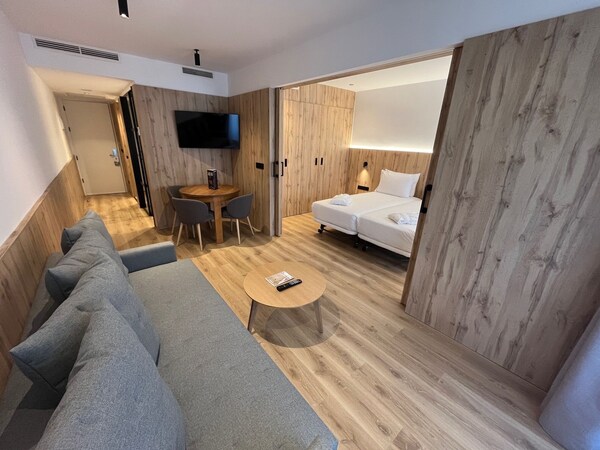 Photo: Expedia
 APARTHOTEL · LAUNDRY · PARKING · CONDE DUQUE
Muralto Madrid Princesa
Just west of Malasaña by the Conde Duque cultural center: a VIP-Access aparthotel with laundry, parking availability, and 8.8 across 366 reviews.
Muralto Madrid Princesa is the other, and it is the better pick if your priority is being able to drive in and out easily rather than being in the oldest streets. It sits on the Princesa side by the Conde Duque centre, which is Malasana adjacent rather than Malasana proper, about a ten minute walk from Dos de Mayo. That location is the point: the streets are wider, the approach is easier, and it still has laundry and breakfast service alongside the parking. It holds 8.8 across 366 reviews at roughly $132 a night. The trade is the walk. If waking up inside Malasana is the reason you chose the barrio, this is not that.
In both cases, parking availability is not the same as a reserved space. Confirm it directly with the property when you book, give them your plate for the restricted zone registration, and ask what it costs per night, because it is usually charged separately from the room.
If your rental has no parking
Which is to say, if you have booked any of the other thirty. This is still solvable.
Ask the property first, before you arrive. Many central operators have an arrangement with a nearby public garage at a negotiated nightly rate, and they can usually register your plate for the restricted zone so the drive to the door is legal. This one email prevents most of the problems in this guide.
Use a public garage and forget the car. There are municipal and private garages throughout the central districts. Book one online for the length of the stay, park once, and treat it as long term storage rather than transport. Do not plan to move the car during the trip. Every move is a new set of decisions about the restricted zone.
Or park outside the centre entirely. If the car is only for the days either side of Madrid, leaving it at a garage near a Metro station outside the restricted zone is cheaper and simpler, and you take the Metro in.
What not to do is arrive without a plan and circle the barrio looking for a space. In the centre, that is how you collect a restricted zone fine while failing to park.
What we would book
For a normal Madrid trip: no car, anything central, and the money saved put towards a better located apartment. If it is your first visit, our first visit guide covers which barrio suits that best, and being car free is one of the reasons central is worth paying for.
For a road trip with Madrid in the middle: Muralto on the Princesa side for the easier approach, or L&H La Latina if you want the old centre and a human at the desk when you arrive at eleven at night.
For a longer stay where a car starts to look tempting: it usually is not, and our long stay guide covers what actually matters over a month, which is laundry, light and a lift rather than a parking space.
Rates, ratings and review counts above are as of our July 2026 curation and move with the season, so treat them as a starting point and confirm on the property page before you book. Traffic rules and fares in Madrid change from time to time as well, so check the current position with the city and with your property before you drive into the centre.